
Project Info
Client
Enterprise Web Platform
Service
Full Stack Web Development
Industry
Technology & SaaS
Stack
Next.js, Prisma ORM, PostgreSQL, REST APIs, Node.js
Challenge
Building a scalable Next.js web application introduced multiple architectural and operational challenges. Managing server-side rendering (SSR), API performance, database connections, and environment configurations required careful planning.
Additionally, handling REST APIs alongside frontend rendering, ensuring secure cross-origin communication (CORS), and managing Prisma database connections in a serverless or hybrid environment posed common yet critical issues.
Our Solution
We designed a modular Next.js application architecture with a clear separation between frontend rendering and backend REST APIs. Prisma ORM was used to standardize database access while PostgreSQL ensured reliability and scalability.
API routes were optimized, environment configurations were standardized, and security best practices were applied to ensure smooth communication between frontend and backend services.
 Clean separation of frontend and REST APIs
- Optimized SSR and API performance
- Scalable database access using Prisma ORM
- Secure REST API communication
- Robust environment and config management
- Production-ready deployment strategy
Common Issues Faced
During development, we encountered typical challenges such as Prisma connection limits, slow SSR responses, API latency, and CORS-related browser restrictions when consuming APIs across different origins.

Prisma database connection pooling issues

CORS errors while calling REST APIs

SSR performance and hydration mismatches
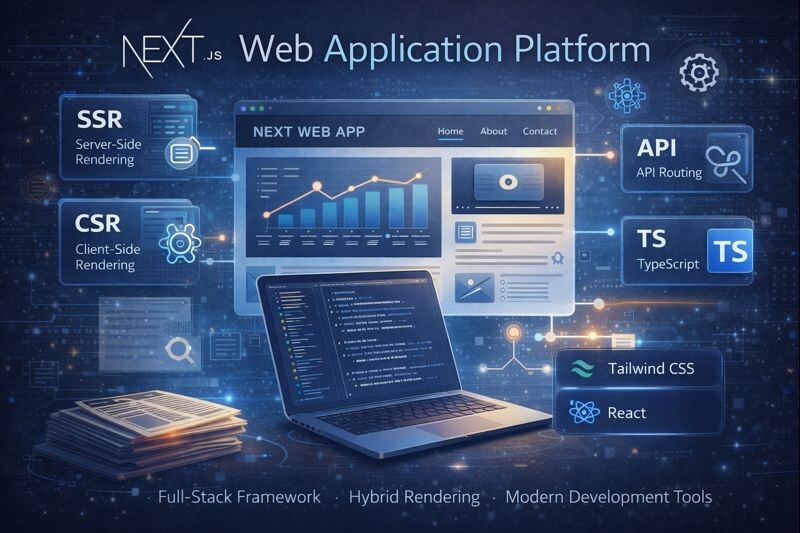
Solutions Implemented
We resolved these challenges by implementing global Prisma clients, proper API middleware for CORS handling, and caching strategies for SSR-heavy pages.

Global Prisma instance with connection reuse

Proper CORS headers and API middleware

SSR optimization and selective client rendering

Conclusion
This project demonstrates the successful delivery of a modern, production-ready Next.js web application backed by a robust backend architecture. By leveraging Prisma, PostgreSQL, and REST APIs, we built a system that balances performance, security, and long-term scalability.

Backend Stability
Developed stable REST APIs with Prisma ORM and PostgreSQL, ensuring reliable data access, consistent transactions, and predictable performance under load.

Performance & Security Handling
Addressed common Next.js challenges such as CORS configuration, API route protection, environment-based setups, and optimized server-side rendering for faster load times.

Production Readiness
Delivered a clean, maintainable codebase with proper error handling, logging, and deployment readiness—allowing the client to confidently scale the application.